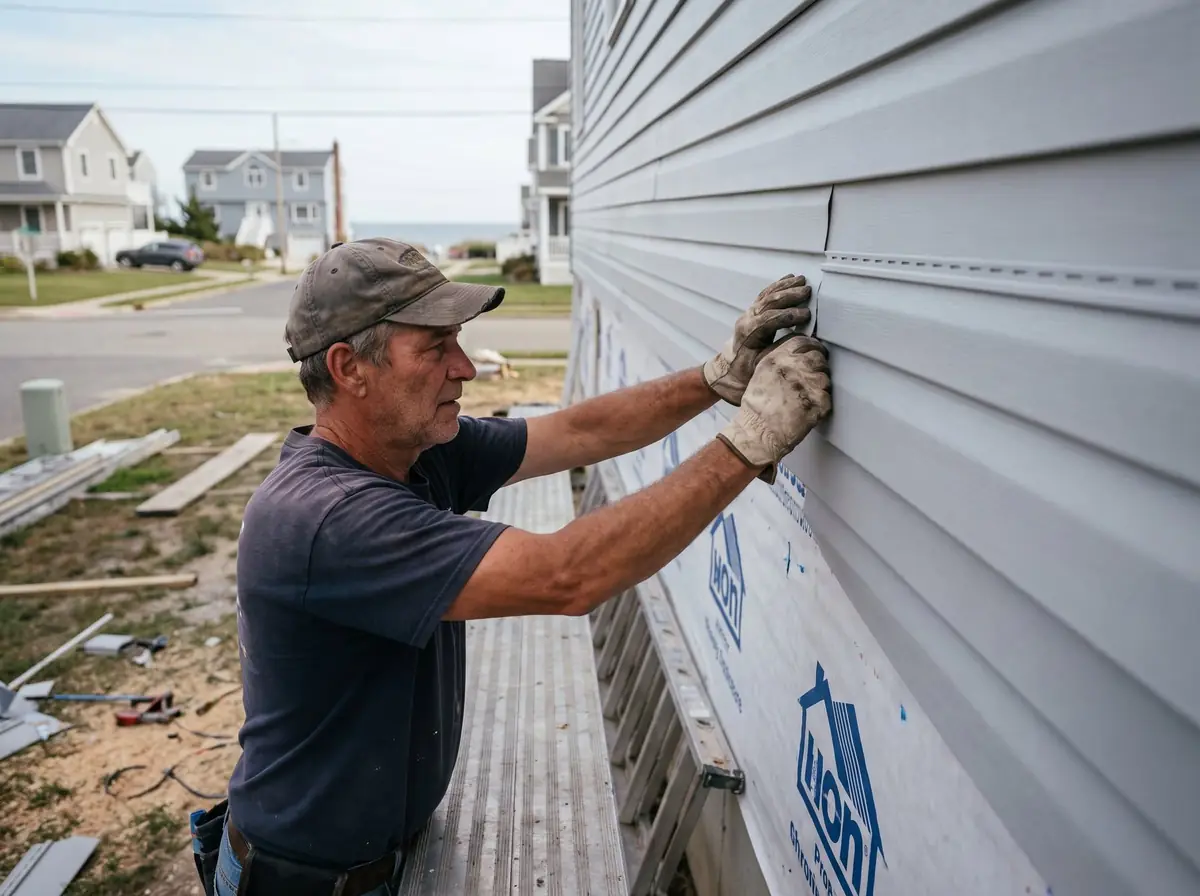
Vinyl siding is a practical coastal-NJ cladding when the wall is prepared correctly, panels have room to move, and fastening and trim details are designed for wind and water.
How much does it cost to replace vinyl siding?
Paragon's 2026 New Jersey planning guide puts installed vinyl siding at roughly $7 to $14 per square foot, or about $11,000 to $28,000 for many single-family homes. The wall area—not interior floor area—sets the base quantity. Tear-off, house wrap, insulation, trim, stories, gables, and concealed sheathing repairs move the final number.
For comparison, Angi's 2026 national data reports a broad $6,372 to $18,379 range. A local written estimate should separate removal, wall repairs, weather barrier, panels, soffit or fascia, trim, disposal, and permits or inspections if required.
How is vinyl siding replaced correctly?
A professional replacement starts by removing loose or failed cladding and inspecting the sheathing, window and door openings, and water-management details. Damaged substrate is repaired before a compatible weather-resistive barrier, flashing, starter strips, corners, channels, and panels are installed. Vinyl must hang from its fasteners rather than being pinned tight because every panel expands and contracts.
The last pass matters: penetrations are flashed, trim transitions shed water, courses remain level, and panels stay locked without being over-nailed. This is why a whole-house siding replacement is more than attaching visible panels.
Standard vinyl or insulated vinyl siding?
Standard vinyl is the lower-cost choice and works well when the wall assembly is sound. Insulated vinyl adds a shaped foam backing that makes the panel feel more rigid, reduces some thermal bridging, and can soften outside noise. It is not a substitute for air sealing, wall insulation, or proper flashing.
For exposed Jersey Shore elevations, compare panel thickness, profile, wind-rating documentation, color-fade coverage, and the complete manufacturer warranty—not just the sample's appearance. Installation conditions and fastening details still control performance.
How long does vinyl siding last?
Quality vinyl siding can serve roughly 25 to 40 years in coastal New Jersey when it is installed correctly and inspected after severe storms. Sun exposure can fade older colors, wind can exploit loose locking edges, and trapped water can damage the wall behind otherwise clean-looking panels.
Wash with manufacturer-approved methods and avoid high-pressure spraying upward into laps. After major wind, look for lifted courses, rattling panels, cracked corners, open trim, and staining around openings.
Can vinyl siding be repaired or painted?
A few cracked or unhooked panels may be repairable when matching material is available and the wall behind them is dry. Repeated blow-offs, brittle panels, widespread fading, or water damage across several elevations point toward replacement. A repair assessment should inspect the reason the panel failed, not merely snap it back into place.
Vinyl can be painted with a coating approved for vinyl and a color within the manufacturer's heat-reflectance limits. Paint changes maintenance needs and may affect warranty terms. Compare that option with replacement on the exterior painting page.
Does vinyl siding replacement need a permit in New Jersey?
Under current NJ DCA guidance, standard wood, vinyl, or aluminum siding replacement on an existing detached one- or two-family home is generally ordinary maintenance that does not require a construction permit. Structural repairs, other occupancies, and materials such as polypropylene, stucco, stone, cultured stone, or brick can change the answer.
Zoning, historic-district, association, and local requirements may still apply. Confirm the exact scope with the municipal construction office before work; see Paragon's current roof and siding permit guide.