Siding
Vinyl Siding Cost in NJ (2026): Prices, Tiers, and What Moves Them
By Paragon Exteriors LLC · Updated June 23, 2026
The straight number
What does installed vinyl siding cost in New Jersey?
Installed vinyl siding in New Jersey falls within the guide’s $7 to $14 per square foot planning range. Wall area, tear-off, house wrap, panel grade, insulation, trim, corners, stories, access, and concealed damage shape the proposal. The written price should identify the full wall assembly because panel-only comparisons omit significant work.
In 2026, vinyl siding costs $7 to $14 per square foot installed in New Jersey, which works out to roughly $11,000 to $28,000 for a typical single-family home. Those figures include tearing off the old siding, wrapping the house, and installing the new panels — not just the material. Where you land inside that range comes down to three things: how much wall you have, which grade of vinyl you pick, and how cut-up your walls are with corners, windows, and gables.
Cost by home size
How does home size affect a siding estimate?
Siding budgets depend on wall square footage rather than interior floor area. Perimeter, wall height, and gable ends help estimate the exterior surface, while home shape changes labor and trim. Two houses with similar area can price differently when one includes more corners, windows, gables, or porch transitions.
Siding is priced on wall square footage, not floor area — a number most homeowners have never measured. A rough shortcut: take the home’s footprint perimeter, multiply by wall height, then add for gable ends. Paragon serves Ocean, Monmouth, Middlesex & Burlington Counties and the Jersey Shore, NJ.
| Home type | Approx. wall area | Typical installed cost (2026) |
|---|---|---|
| Small ranch / cape | 1,100–1,500 sq ft | $11,000 – $16,000 |
| Mid-size split or 2-story | 1,600–2,200 sq ft | $15,000 – $22,000 |
| Large colonial (complex trim) | 2,300–3,000 sq ft | $20,000 – $28,000+ |
Complexity matters as much as size. Two homes with identical square footage can differ by thousands if one is a clean rectangle and the other has three gables, a bay window, and a wraparound porch — every corner, cut, and transition is labor and trim.
Cost by grade
How does vinyl siding grade affect the product?
Mid-grade vinyl is listed around 0.044” thick in the guide’s comparison. Panel thickness, profile, and finish distinguish builder, mid-grade, and premium products. The section favors stronger panels for Shore homes because material rigidity and color performance matter alongside the labor already invested in a whole-house installation.
Not all vinyl is the same plastic. Panel thickness (measured in mils), profile, and finish quality separate a 20-year builder panel from a 40-year premium one.
| Grade | Panel thickness | Material cost /sq ft | What you get |
|---|---|---|---|
| Builder-grade | ~0.040” | $0.90 – $1.60 | Thin, more flutter, fewer colors |
| Mid-grade | ~0.044” | $1.60 – $2.50 | The NJ sweet spot — rigid enough, good color range |
| Premium / insulated | 0.046”+ | $2.50 – $4.50 | Thick, low flutter, fade-resistant, insulated backing |
For most Jersey Shore homes we steer people toward mid-grade or insulated panels. Builder-grade saves a little upfront and then rattles and oil-cans in the first real wind off the bay. The material delta between grades is a few thousand dollars on a whole house — small next to the labor already in the job, and the part you feel every windy night.
The five things that move your price
What scope items can move a vinyl siding price?
Hidden sheathing repair can cost about $60–$100 per sheet installed according to the guide. Tear-off conditions, house wrap, flashed openings, trim, wall height, access, and insulated backing also affect siding price. These items explain why panel-only comparisons miss labor and moisture-management work that belongs in a complete exterior scope.
- Tear-off and what’s underneath. Pulling old vinyl is quick. Pulling old cedar, aluminum, or asbestos-look panels — or finding rotted sheathing behind them — adds cost. Sheathing repair runs about $60–$100 per sheet installed, and older shore homes hide more of it than people expect.
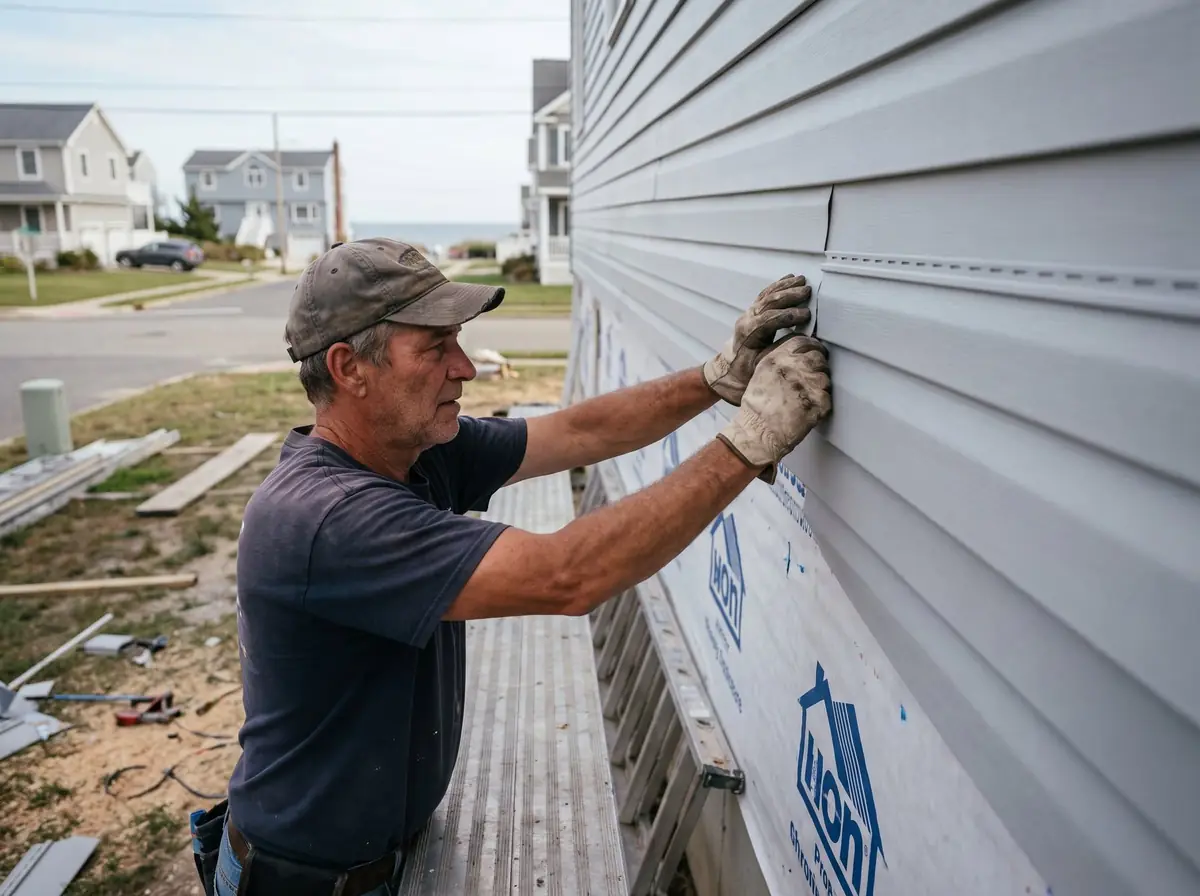
- House wrap and moisture detail. A proper weather-resistive barrier (Tyvek-style wrap) and flashed window openings are non-negotiable near the coast. Skipping it is how water gets behind siding and rots the wall you just paid to cover.
- Trim and accessories. J-channel, corner posts, soffit, fascia wrap, and window surrounds are where quality shows and where cheap bids quietly cut. Real trim work can add 15–25% but it’s what makes the job look built rather than wrapped.
- Wall height and access. Three-story shore homes, tight lots, and second-story gables over rooflines mean staging and slower work.
- Insulated vs. standard. Insulated backing adds roughly $1.50–$3.00 per square foot but improves rigidity, sound, and a modest R-value — often the right call within a few miles of the water.
Vinyl vs. the alternatives
How does vinyl siding compare with other materials?
Vinyl is the lowest-priced option in the guide’s material table at $7 – $14 installed per square foot. Insulated vinyl, fiber cement, and engineered wood occupy higher ranges with different durability and maintenance profiles. The comparison frames vinyl as the value and low-maintenance choice rather than treating all siding products as interchangeable.
Vinyl wins on price and near-zero maintenance, but it’s worth knowing where it sits.
| Material | Installed /sq ft | Lifespan | Notes |
|---|---|---|---|
| Vinyl | $7 – $14 | 25–40 yrs | Cheapest, no repainting, most popular in NJ |
| Insulated vinyl | $9 – $16 | 30–40 yrs | Stiffer, quieter, small energy bump |
| Fiber cement (Hardie) | $13 – $22 | 40–50 yrs | Impact/fire resistant, heavier, needs paint cycle |
| Engineered wood | $11 – $18 | 20–30 yrs | Warm look, more upkeep |
If you’re torn between vinyl and fiber cement, we wrote a full breakdown: James Hardie vs. vinyl siding. The short version — vinyl for value and hands-off ownership, Hardie for impact resistance and a painted look you’re willing to maintain.
Why the Jersey Shore changes the math
Why does Jersey Shore exposure change siding decisions?
Salt air doesn’t corrode vinyl, giving it an advantage over aluminum near the water. Coastal wind still makes correct fastening important, while sun exposure can affect color and humid walls punish weak wrap or flashing details. The guide also notes that many Ocean and Monmouth County towns require permits for full re-siding.
Salt air doesn’t corrode vinyl, which is a real advantage over aluminum near the water. But three coastal factors deserve attention. Wind is the big one: barrier-island and bayfront homes from Seaside Heights to Long Beach Island need panels nailed to spec — snug but not tight, so the vinyl can expand and move without pulling loose in a 60 mph nor’easter gust. Under-nailed vinyl is the number-one wind failure we see, and it’s an install problem, not a product one. Sun fade hits south- and west-facing walls hardest; premium panels use fade-resistant pigments that hold color far longer. And moisture: humid coastal walls punish any shortcut in the house wrap and flashing, so that hidden layer matters more here than inland.
Township permits apply too — most Ocean and Monmouth County towns require a construction permit for a full re-side, and we handle that paperwork as part of the job.
How to compare siding quotes
How should homeowners compare vinyl siding quotes?
Comparable siding quotes should identify panel grade, thickness, tear-off, house wrap, trim, licensing, and insurance. The guide lists Paragon’s New Jersey home-improvement license as #13VH13814500. A low total can hide omitted preparation or accessories, so matching the written scope matters more than comparing a generic siding label.
Siding bids are easy to game because so much of the value is hidden behind the panel. Line these up before you sign:
- Grade and thickness, in writing — “vinyl siding” on a quote means nothing without the panel spec.
- Tear-off included, or a layover? Going over old siding saves money and traps moisture — get a real reason if it’s proposed.
- House wrap named — brand and coverage, not “we wrap it.”
- Trim scope — corners, J-channel, soffit, fascia, window wraps spelled out.
- License and insurance — verify the NJ HIC (ours is #13VH13814500) and the certificate of insurance.
A bid that’s thousands lower than the rest is almost always cutting tear-off, trim, or grade — the parts you can’t see from the curb until they fail.
Get an exact siding number
Ranges get you oriented; your walls deserve a real measurement. Planning other exterior work at the same time, like new windows or roofing? Bundling the tear-off and staging usually saves on both. Current third-party financing options may be available, subject to lender disclosures, terms, and approval. Paragon is not a lender and does not guarantee approval or a particular payment. Related services: siding estimates, Toms River, new windows, roofing, and Request your free estimate.