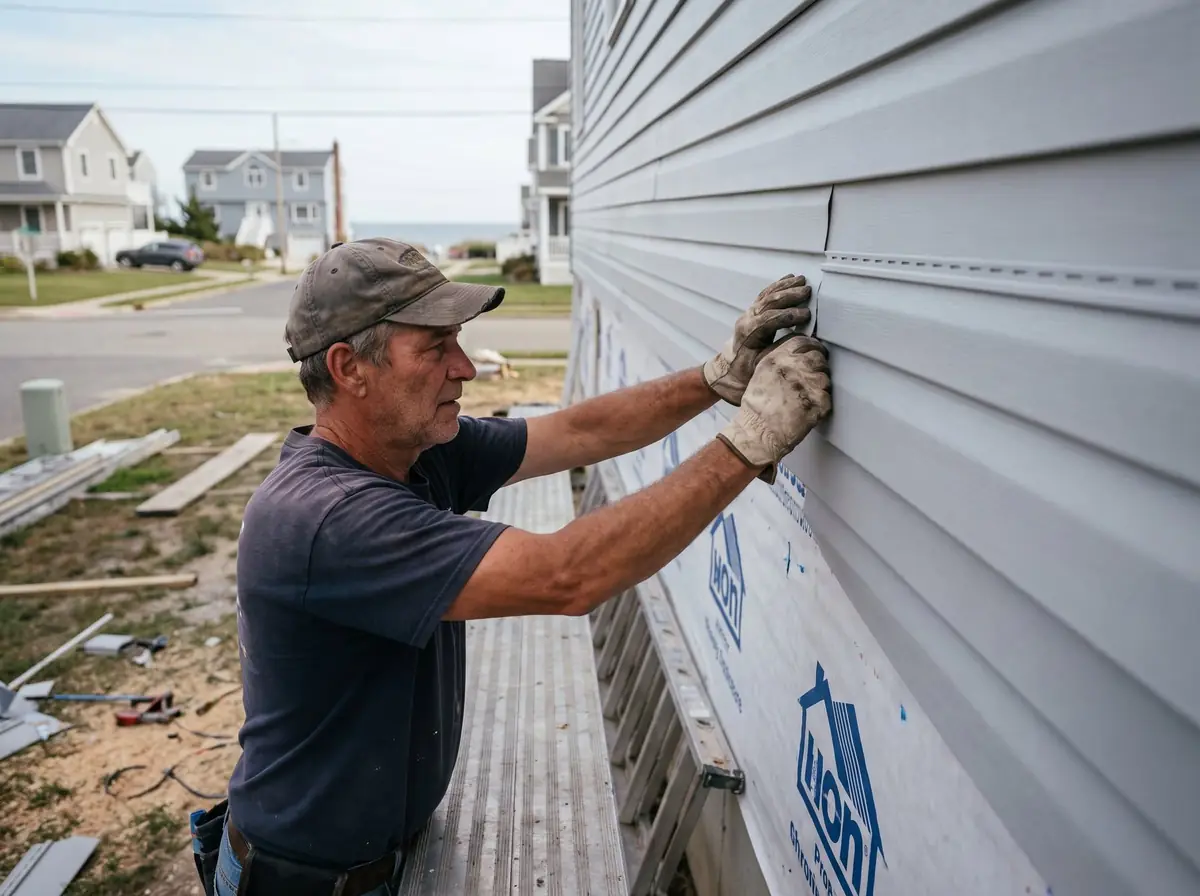
Siding built like a system, not a skin
Paragon serves Ocean, Monmouth, Middlesex & Burlington Counties and the Jersey Shore, NJ. Every job includes full removal of the old cladding, a sheathing inspection, new house wrap with taped seams, and materials matched to how close your house sits to saltwater. Paragon Exteriors is registered as a New Jersey home-improvement contractor (NJ HIC #13VH13814500). Ask for the current insurance certificate and any trade-license attribution required for the proposed scope.
The panels are what you see; the system underneath is what decides whether your walls stay dry for 30 years. That’s where we refuse to cut.
Pick the material by the block you live on
Three miles inland, standard vinyl performs for decades. On a bayfront street, the same panel chalks, fades, and turns brittle years ahead of schedule. Here’s how the three options we install most actually compare:
| Material | Typical whole-house cost | Where it earns its keep |
|---|---|---|
| Standard vinyl (.044”+ gauge) | $9,000 – $14,000 | Best value inland — never needs paint, huge color range, solid 25+ year performer away from direct salt exposure |
| Insulated vinyl | $12,000 – $18,000 | Foam-backed panels add continuous R-value, hide wavy old walls, and resist dents — the sweet spot for pre-1990 Shore homes |
| Fiber cement (James Hardie) | $16,000 – $25,000 | The premium play: fire-rated, impact-proof, holds dark colors near the water, real painted-wood character |
Not sure which side of the vinyl/fiber-cement line you fall on? Our guides break down what vinyl siding really costs in NJ and James Hardie vs. vinyl head-to-head — or ask for both numbers in your estimate and compare line by line.
What goes on before a single panel does
Most siding failures we’re called to fix weren’t panel failures — they were installation shortcuts hiding underneath. Every Paragon siding job includes:
- Complete strip-off of the existing siding — we don’t bury old problems under new panels
- Sheathing inspection with rotted or delaminated sections replaced on the spot
- Premium house wrap, seams taped, laps shingled the right direction
- Flashing at every window, door, and penetration — the detail that separates dry walls from hidden rot
- Optional rigid foam or insulated panels for continuous insulation over the studs
- Corrosion-resistant fasteners on homes near saltwater, nailed to spec — vinyl pinned too tight buckles in the first July heat wave
- Matching trim, corners, and soffit work so the finished house reads as one design, not a patch job
The salt-air problem, solved at the spec level
Jersey Shore siding fights on two fronts. Sun and salt attack the surface — that’s the chalky film on your palm when you touch a 15-year-old wall. Wind attacks the fastening — a nor’easter gust that gets under one unlocked course can unzip a whole elevation. We counter both: fade-resistant capstock or factory-finished fiber cement for the surface, heavier panel gauge and fully locked, wind-rated installation for the structure. It’s the same philosophy we bring to every roof we install: build for the weather your house actually gets, not the national average.
Color is the payoff — pick it once, enjoy it for decades
New siding is the biggest curb-appeal move you can make, and modern materials finally make bold choices safe. Deep blues, charcoals, and coastal greens that would have faded blotchy a generation ago now carry serious fade protection. We’ll show you full-size samples against your actual house — and where a design wants more, we mix profiles: board-and-batten gables, shake accents on a front elevation, wide trim that frames it all.
While the walls are open is also the cheapest moment to deal with drafty openings — many customers pair siding with replacement windows and have gutters refit in the same visit, one crew and one disruption instead of three.
Get the itemized number
Your estimate lists materials, gauge, wrap, flashing, and labor line by line — compare it against any other quote and see exactly what they left out. Current third-party financing options may be available, subject to lender disclosures, terms, and approval. Paragon is not a lender and does not guarantee approval or a particular payment. Related links: financing information and Request your free estimate.
Project planning guide
Answers for planning your project
When should siding be replaced instead of repaired?
Repair is reasonable for isolated cracks, loose panels, small impact areas, or one failed trim detail when compatible material is available and the wall behind it is dry. Widespread brittleness, repeated wind loss, rot, buckling, chronic water entry, failing sheathing, or many mismatched repairs favor full siding replacement.
How do you repair siding on a house?
The first step is finding why the siding failed. A correct repair may replace panels, reset locking edges, restore fastening, rebuild a damaged corner, correct flashing, or repair the wall behind the cladding. Simply covering a crack can trap the real water-management problem. Repair and replacement are explained together so homeowners can compare the least disruptive durable option.
Fiber cement siding, soffit, and fascia installation
Fiber cement offers a different appearance, weight, cutting method, fastening schedule, clearance requirement, and paint system than vinyl. Soffit and fascia complete the eave, protect roof edges, and help support a planned ventilation path. These components are scoped with flashing and wall preparation rather than sold as disconnected cosmetic strips. Homeowners focused on vinyl can compare panel grades and pricing on the vinyl siding installation page.
Services available for this type of project
- Fiber cement siding installation
- Siding installation
- Siding repair
- Siding replacement
- Soffit and fascia installation
A project may combine several of these services. We inspect the property, confirm priorities, and define the work in a written proposal before construction begins.