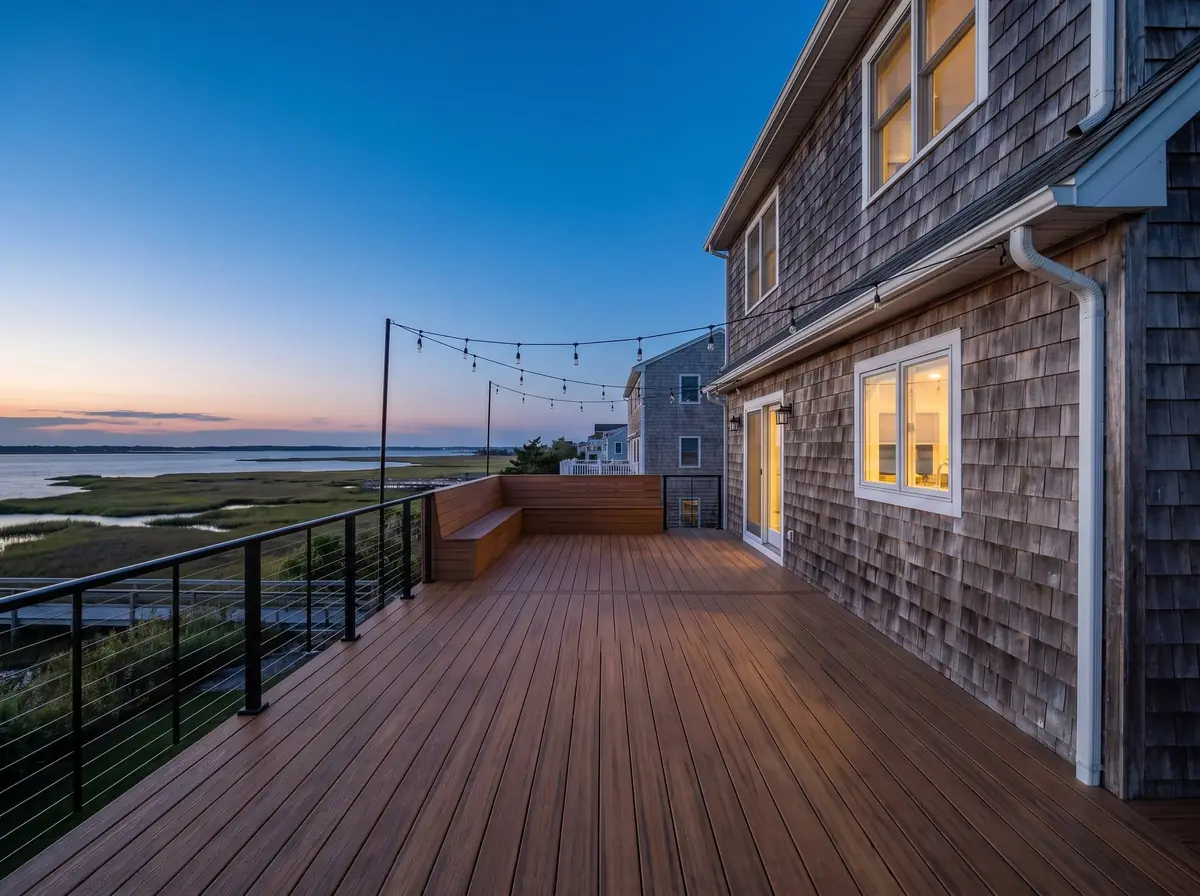
Composite decking costs more upfront than pressure-treated boards, but its low maintenance and long service life can make it the better value for homeowners who plan to keep the deck.
How much does composite decking cost?
Composite deck pricing depends on the entire structure, not the board carton. Paragon's 2026 NJ guide places many mid-size composite decks around $13,000 to $22,000, while larger, elevated, PVC, multi-level, or premium-railing projects can run $24,000 to $48,000 or more. Demolition and structural repair add to replacement projects.
Ask each bidder to identify board line, hidden fasteners, framing, joist protection, fascia, stairs, railing, lighting, permits, disposal, and warranty responsibilities. A low board allowance can make two proposals look comparable when the finished systems are not.
How long does composite decking last?
Many composite deck systems are designed for roughly 25 to 30 years or longer, depending on product line, installation, exposure, cleaning, and the structure underneath. The frame and connections must be designed to last with the surface; premium boards do not correct poor ledger flashing, undersized framing, trapped water, or corroding hardware.
Read the manufacturer's current residential warranty for fade, stain, structural, labor, and transfer terms. Warranties differ and usually require installation and care that follow the published instructions.
Is composite decking worth the extra cost over wood?
It often is for owners who value lower maintenance and expect to use the deck for many years. Pressure-treated wood costs less initially but needs periodic cleaning, staining, and sealing. Composite avoids routine stain work, does not splinter, and offers consistent color and texture, but it still needs cleaning and can show heat, scratching, or expansion issues when poorly selected or installed.
Compare life-cycle cost, not only the first invoice. The deck installation hub explains where wood still makes sense and why framing quality is material-neutral.
Does composite decking get hot or slippery?
Every deck surface warms in direct sun. Darker colors and dense boards can feel hotter, while lighter colors and some heat-mitigating product lines stay more comfortable. Samples should be viewed outside in sun rather than under showroom lighting. Shade, orientation, airflow, and footwear also affect comfort.
A clean composite surface is generally walkable, but pollen, algae, ice, grease, and standing water can make any deck slippery. Proper drainage, manufacturer-approved cleaning, and a texture suited to the setting matter around pools, stairs, and shaded shore homes.
What maintenance does a composite deck need?
Composite is low maintenance, not no maintenance. Sweep debris from gaps, keep drainage paths open, wash with the manufacturer's approved method, clean spills promptly, and avoid chemicals or pressure settings the warranty forbids. Inspect railings, stairs, ledger areas, flashing, posts, and visible connectors each year and after severe coastal storms.
Do not use a metal shovel or assume every deicer is approved. Follow the exact care guide for the installed product because capped composite, traditional composite, and PVC can have different instructions.
The frame under a composite deck matters most
Composite boards are only the visible layer. Joist spacing, beam sizing, blocking, lateral connections, ledger attachment, flashing, footings, ventilation, and corrosion-resistant hardware determine how solid the deck feels and how long it remains serviceable. Picture framing and diagonal layouts can require additional structure.
For a resurfacing project, Paragon checks the old frame before pricing the surface. If the frame is not a sound match for the selected board's service life, compare deck replacement with targeted structural work.